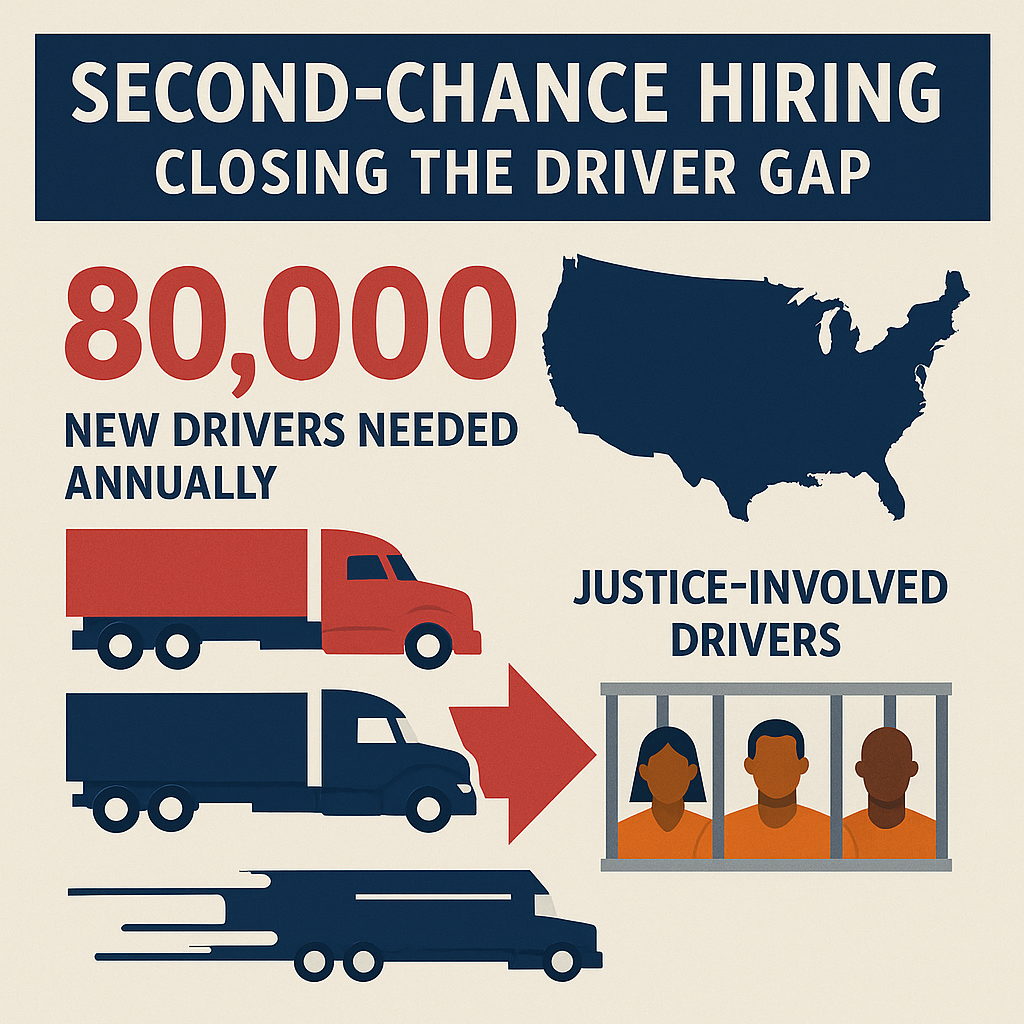
With a persistent driver shortage that needs about 80,000 new commercial drivers every year in the US, the logistics industry is caught in a conundrum. Amid the crisis, more and more employers are looking beyond the ordinary and are recognizing the unused resource of justice-involved drivers—individuals returning to society after serving their time. By employing second-chance CDL hiring approaches and teaming up with reentry trucking programs, carriers could not only fill the gap but also welcome an energized workforce of a different sort.
1. What is Justice-Involved Talent
Justice-involved talent is a term for individuals who have been convicted of crimes and are trying to live a normal life. This group has difficulty seeking jobs because of background checks, licensing restrictions, and societal stigma. Obtaining a Class A Commercial Driver’s License (CDL) is a good option for many: drivers who finish the training can then find jobs in areas across the country, earn a good wage, and gain access to formal training.
- Reentry: The process wherein ex-inmates reintegrate into society.
- Programs: Consistently enacted—mainly through federal, state, or nonprofit funding that address job training, mentorship, and placement.
2. Why Second-Chance CDL Hiring Has a Significance
- Workforce Expansion
- Using a larger talent pool can be the magic wand that solves driver shortages. Even if only a few of the justice-involved candidates meet success through reentry trucking programs, the overall improvement in fleet capacity will be significant.
- Using a larger talent pool can be the magic wand that solves driver shortages. Even if only a few of the justice-involved candidates meet success through reentry trucking programs, the overall improvement in fleet capacity will be significant.
- Social Responsibility
- By hiring people looking for redemption, carriers will act as corporate citizens. This not only increases the good reputation of the company but also indirectly brings goodwill to the community.
- By hiring people looking for redemption, carriers will act as corporate citizens. This not only increases the good reputation of the company but also indirectly brings goodwill to the community.
- Retention and Loyalty
- Justice-involved drivers are often very thankful and loyal to the company, which leads to better retention compared to hiring traditional workers.

3. Structure of Reentry Trucking Programs
Disparate to the different methodologies, costs, and timeframes of reentry trucking programs, they can be categorized into various categories. Below is a comparative table listing the characteristics of a few programs:
| Program Name | Length | Cost to Participant | Support Services | Employer Partnerships |
| Federal Work-Study CDL Track | 8–12 weeks | Free | Housing, counseling, job placement | Major national carriers |
| State-Sponsored CDL Initiative | 6–10 weeks | Subsidized ($500–$1,000) | Career coaching, legal aid | Regional carriers, local fleets |
| Nonprofit CDL Fast-Track | 4–8 weeks | Donor-funded (Free) | Mentorship, life skills workshops | Small to mid-sized independent carriers |
| Private Training & Placement | 10–14 weeks | Market rate ($3,000+) | Veteran services, mental health support | Dedicated employer networks |
Table 1: Common reentry trucking programs comparison
4. Main Elements of Effective Second-Chance CDL Hiring
- Pre-Hire Assessment
- Rethink about a driving aptitude test, go for a thorough background check, and assess how ready is the potential candidate to enter the labor market. RTW sometimes organize mock road tests or use validated behavioral assessments to evaluate potential hires.
- Rethink about a driving aptitude test, go for a thorough background check, and assess how ready is the potential candidate to enter the labor market. RTW sometimes organize mock road tests or use validated behavioral assessments to evaluate potential hires.
- Partnerships with Training Providers
- Connect with reliable reentry trucking programs that offer mixed forms of support—technical CDL teaching and wrap-around services (like housing assistance, counseling, and legal guidance).
- Connect with reliable reentry trucking programs that offer mixed forms of support—technical CDL teaching and wrap-around services (like housing assistance, counseling, and legal guidance).
- Structured Onboarding
- Set up policies that are brief, clear, and specific about the expectations from employees as well as the support and the measurements that will be made. Mentorship from experienced drivers can help him speed up the integration process and acquire new skills.
- Set up policies that are brief, clear, and specific about the expectations from employees as well as the support and the measurements that will be made. Mentorship from experienced drivers can help him speed up the integration process and acquire new skills.
- Ongoing Support & Monitoring
- Continue check-ins from managers or peers at all times. All these tracking metrics such as timely deliveries, incidence of accidents, and job retention can be utilized in enhancing the hiring process.
- Continue check-ins from managers or peers at all times. All these tracking metrics such as timely deliveries, incidence of accidents, and job retention can be utilized in enhancing the hiring process.
5. Advantages to Carriers
- Reduced Recruitment Costs: Many of these programs will subsidize or cover training costs, which results in lower hiring expenses upfront.
- Increased Diversity & Inclusion: The employing of second-chance CDL hiring not only assures courts about inequity of opportunity, but it also finds a market in socially responsible customers and investors who are like-minded.
- Customer Trust Through Employee Loyalty: Research has found that hires who had a justice-intervention experience stay longer in companies.
6. The Integration of Second-Chance Strategies: A Step-by-Step Guide
- Policy Revision
- Make hiring rules more flexible and consider convictions on a case-by-case basis instead of enacting an all-encompassing ban.
- Make hiring rules more flexible and consider convictions on a case-by-case basis instead of enacting an all-encompassing ban.
- Legal Compliance
- Make sure to comply with Federal Motor Carrier Safety Administration (FMCSA) regulations, and those of individual states that license specific drivers. Some convictions make it mandatory for carriers to wait a certain period before their CDL eligibility can be activated.
- Make sure to comply with Federal Motor Carrier Safety Administration (FMCSA) regulations, and those of individual states that license specific drivers. Some convictions make it mandatory for carriers to wait a certain period before their CDL eligibility can be activated.
- Stakeholder Education
- Refresh the knowledge of the HR and operational staff on the reason for the second-chance CDL hiring and the value added by justice-involved drivers.
- Refresh the knowledge of the HR and operational staff on the reason for the second-chance CDL hiring and the value added by justice-involved drivers.
- Community Outreach
- Pray for the local reentry organization, partnerships with the probation and parole offices, and vocational schools to supply you with a good candidate pipeline.
- Pray for the local reentry organization, partnerships with the probation and parole offices, and vocational schools to supply you with a good candidate pipeline.
- Pilot Program Launch
- Conduct the program with a small group before extending it to all company branches. This way, the company can test for operations efficiency, ensure support is delivered, and measure results before the wider rollout.
- Conduct the program with a small group before extending it to all company branches. This way, the company can test for operations efficiency, ensure support is delivered, and measure results before the wider rollout.
- Data Collection & Analysis
- Monitor core performance metrics such as: CDL exams’ passing rates, delivery driving performance, retention rates after 3 and 6 months of service, and safety management.
- Monitor core performance metrics such as: CDL exams’ passing rates, delivery driving performance, retention rates after 3 and 6 months of service, and safety management.
7. Case Example: Leadgamp Achieved Subtle Success
A midsize carrier collaborated with Leadgamp, a workforce solutions company, to promote second-chance CDL hiring. By implementing a not-for-profit’s 8-week reentry trucking program into their recruitment funnel, the carrier surprised all with:
- a 90% CDL exam pass rate among justice-involved candidates
- 50% decrease in the first year turnover compared to the reference group
- 20% improvement in regard to the on-time delivery performance of newcomers
The mention of Leadgamp at this point in the article is not to give it a high profile, but rather you should understand how long-term results behind these kinds of operations, like our driver leasing model, attract capable partners even when program fundamentals are not taken away.

8. Solutions for Common Challenges
| Challenge | Mitigation Strategy |
| Licensing Restrictions | Work with state DMV to clarify eligibility timelines. |
| Insurance Hurdles | Negotiate policy riders or higher premiums for initial period; leverage loss data from pilot to renegotiate. |
| Stakeholder Resistance | Share success metrics from similar carriers; offer site visits. |
| Participant Support Needs | Budget for wraparound services; tap into government grants or nonprofit funding streams. |
Table 2: Overcoming barriers in second-chance hiring
8.1. Liability & Insurance
- Providing aggregated safety data that show program graduates have low incident rates.
- Starting participants on less-risky routes (regional vs. long-haul) during their probationary period is what we offer help with.
8.2. Community & Culture
- Organizing informative sessions, displaying testimonies of successful participants plus offering a chance for inquiries are methods that can dissolve second-chance CDL hiring misunderstandings among stakeholders.
9. Best Practices for Sustainable Programs
- Continuous Feedback Loops
- Get feedback from the drivers as well as the trainers about what can be improved in the curriculum, scheduling, and support services.
- Get feedback from the drivers as well as the trainers about what can be improved in the curriculum, scheduling, and support services.
- Scalability Framework
- Develop a process for scaling the program, such as documenting protocols, creating playbooks, and appointing program champions to ensure consistency throughout the initiative’s growth.
- Develop a process for scaling the program, such as documenting protocols, creating playbooks, and appointing program champions to ensure consistency throughout the initiative’s growth.
- External Accreditation
- Create partnerships with accredited training bodies to guarantee adherence with FMCSA regulations while also facilitating government or state funding.
- Create partnerships with accredited training bodies to guarantee adherence with FMCSA regulations while also facilitating government or state funding.
- Marketing & PR
- Use the positive stories (with permission from the participants) in the company newsletter or local media to reaffirm the positive cooperation.
- Use the positive stories (with permission from the participants) in the company newsletter or local media to reaffirm the positive cooperation.
10. Summarization
The trucking industry is in a crisis over the number of drivers. The innovative way to solve this issue is to put into practice second-chance CDL hiring and work alongside reentry trucking programs. Thus, not only do carriers fill the gaps in the workforce but also they become advocates for justice and community reintegration. As the collaboration with Leadgamp shows, well-structured support, data-based decisions, and education of stakeholders are essential to demonstrate the full capacity of individuals who caused justice. The ultimate gain is a healthy atmosphere: motivated and reliable employees for the carriers and a trustworthy chance to rebuild life for the people in need.
Fiddle Associating: Reentry CDL Hiring for Justice-Involved Talent
1. What is second-chance CDL hiring?
It is a training through specialized reentry trucking programs for individuals who have criminal records to acquire a Class A Commercial Driver’s License.
2. How long do reentry trucking programs typically last?
The duration of most programs is between 4 and 14 weeks, depending on factors such as funding, support services, and curriculum intensity.
3. Why should carriers consider justice-involved drivers?
Because they tend to demonstrate greater loyalty, longer retention, and lower turnover rates, which means that they also substantially save costs from the training.
4. What support services are essential for successful reintegration?
Candidates are in a better position to tackle personal and logistical barriers quickly through all-round services such as housing assistance, legal aid, counseling, and mentorship.
5. How can carriers monitor the effectiveness of their second-chance initiatives?
They can measure the success of the program by monitoring metrics such as allotment rates for CDL tests, on-time delivery, accident incidents, and retention within 3 to 6 months, and thus evaluate the program.
6. Are there insurance or liability challenges when hiring justice-involved drivers?
Yes. Reduce risk by having graduates start on low-risk regional routes, agree to a temporary policy rider, and use pilot data proving better premiums.
7. What legal compliance measures should businesses observe?
Read up on FMCSA rules and state DMV protocols to ascertain waiting duration/s after conviction, apply the right background check processes, and keep well-defined case by case hiring policies.
8. How was Leadgamp well off with its pilot program?
With the inclusion of a nonprofit CDL track spanning 8 weeks, the partner carrier of Leadgamp achieved a 90% success rate in CDL, a turnover of first-year employees that is 50% lower, as well as a 20% increase in deliveries made on time.