Opening
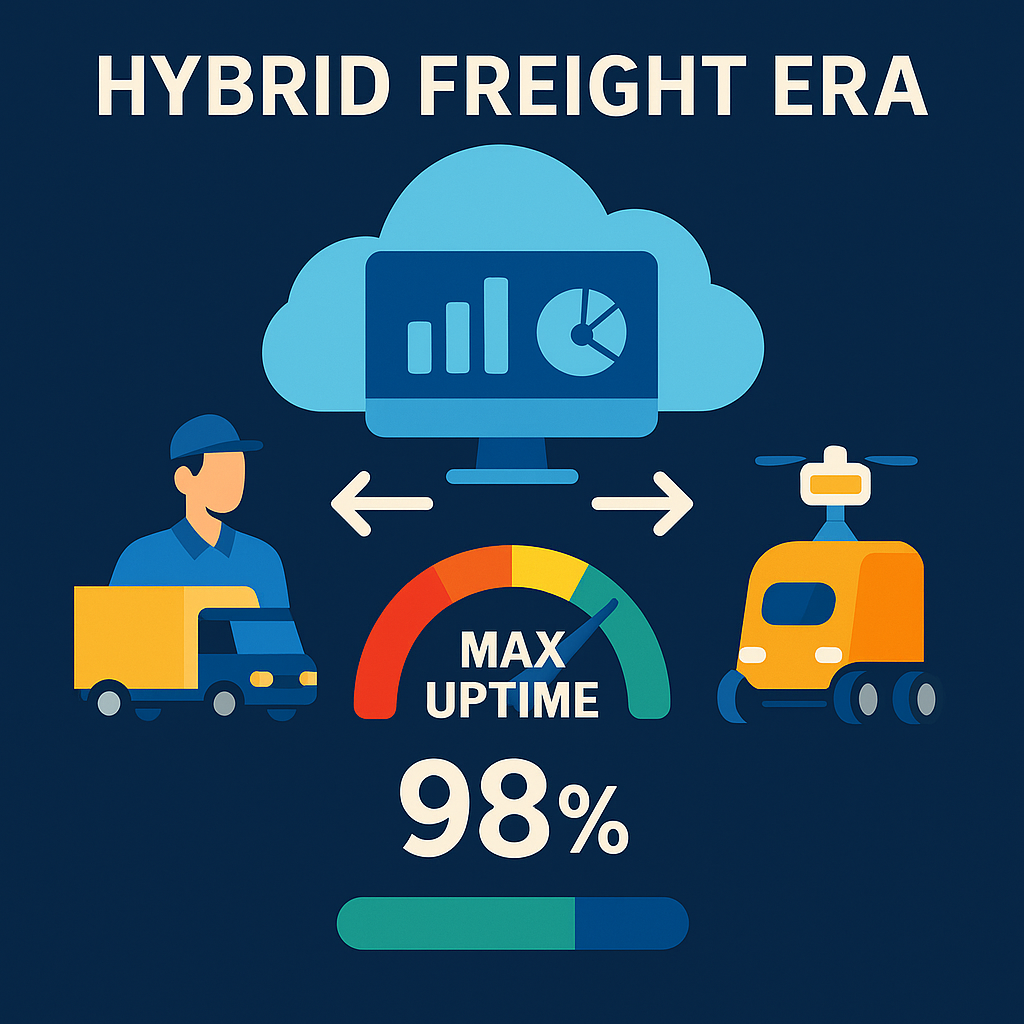
In the logistics sector, that merges traditional trucking chalking the patterns with the new-age automation makes not a distant dream but a reality. The hybrid freight era is the new intricacies where the fleets of both human drivers and autonomous machines are organized by cloud-based platforms. Using hybrid freight SaaS solutions, it is possible for the operators to utilize human-robot scheduling and achieve max uptime hauling and improvements that were never seen before.
The Alterations of Freight and Automation
Conveying products has always been about the secure way, yet the means and strategies have evolved tremendously in the last 10 years. The journey began with the GPS’s route optimizing software through to the company’s artificial intelligence decision-makings. Over the years, technology has propelled its way through:
- Manual Scheduling (Pre-2015): Dispatchers communicated through the phone, used whiteboards, and spreadsheets.
- Digital Dispatch Platforms (2015–2020): The launch of cloud apps enabled features like real tracking and basic algorithmic assignments.
- Autonomous Vehicles & Drones (2021–Present): Robots have been doing the last bit of the delivery and also the yard shuttles responsibilities.
- Hybrid Ecosystems (Present–Future): Humans and robots work together, managed by SaaS platforms that balance strengths and weaknesses.
This leap to the digital dispatch is a clear example of change: it says that flexibility of people and robot accuracy should be applied together.
What Sets a Hybrid Freight SaaS Apart?
A hybrid freight SaaS platform is essentially a unifying dashboard that combines information from various sources, including GPS trackers, telematics sensors, warehouse management systems, and autonomous vehicle controllers. Unique features include:
- Dynamic Resource Allocation: Get trucks or autonomous shuttles back on schedule simply by changing their routes if delays arise.
- Predictive Maintenance Alerts: Machine-learning models can indicate potential breakdowns and alert whether anything would have gone wrong.
- Load Balancing Between Humans & Robots: For each haul, the choice can be made in a way that a vehicle is more suited for that kind of distance, cargo, and time than human drivers.
- Real-Time Performance Metrics: Monitor fleet-wide uptime, idle times, and average delivery speeds.
Enabling these capabilities for logistics managers means the equipment’s optimal schedule becomes possible for every trip, leading to uptime and wasted resources being reduced.
The Working of Human-Robot Scheduling

The essence of human-robot scheduling is, first of all, the recognition of the strengths of each actor:
- Humans: Creative problem-solving, simultaneous decision-making, and handling complex, unstructured environments, such as city streets or rural backroads.
- Robots: They are precise, operate around the clock without fatigue, and follow safety protocols without mistakes.
Major Steps in Hybrid Scheduling
- Task Assessment: Analyze the complexity, distance, and customer needs for each freight assignment.
- Resource Matching: Use algorithms to determine which human drivers or autonomous units are assigned to each task.
- Real-Time Adjustments: Continually monitor progress and reassign tasks if possible to a different resource.
- Feedback Loop: The performance data is included in the scheduling engine for improvement on future assignments.
If these are blended into the carrier’s operation, then they can reach the desired state of max uptime hauling in which there are always loads returning back to the customer either at the day or at night.
Value of Merging Humans and Robots
| Metric | Human-Only Fleets | Robot-Only Fleets | Hybrid Fleets |
| Uptime | ~85% | ~95% | 98%+ |
| Scheduling Flexibility | High | Low | High |
| Safety Compliance | Variable (–5% incidents) | Consistent (0% incidents) | Consistent |
| Cost per Mile | $1.50–$1.80 | $1.20–$1.40 | $1.30–$1.50 |
| Maintenance Downtime | 5–7% annually | 3–4% annually | 3–5% annually |
| Environmental Footprint | Moderate | Low | Low |
Note: Figures are illustrative averages based on recent industry surveys.
As the table signifies, hybrid operation is the best because of the high reliability, near-robotic, and the flexibility of the human decision.

Concrete Steps of Change: A Stealthy Wave to Trucking Talent
Despite numerous players still being in the experimental stage, early birds have gained a lot of fantastic benefits. For example, we, at Trucking Talent, noticed that just implementing a hybrid scheduling module resulted in a 15% drop in empty-mile runs just in the first quarter. This amount of progress was achieved through the minimization of expenses and carbon emissions. It is underlined that changing freight could gain results that go far beyond financial benefits.
Foundations for Max Uptime Hauling
Realizing max uptime hauling is only possible when you are conscious of multiple factors connected to it:
- User-Friendly Interfaces: It should take just a click for dispatchers to bypass automatic prompts and redirect them.
- Scalable Architecture: The SaaS backbone must carry the load of several thousand scheduling decisions in parallel without latency.
- Robust API Integrations: FLUX capabilities provide seamless data exchange with TMS (Transportation Management Systems) & more.
- Adaptive Learning Models: Data from operations used in machine-learning algorithms would be a regular thing to come across.
- Redundant Communication Channels: Ensure that you are connected through cellular, satellite, and Wi-Fi to avoid blind spots.
Sticking to these principles ensures that no truck or robot is left idle for a moment longer than necessary.
Beating the Odds in a Hybrid Environment
Introducing a hybrid fleet model comes with certain obstacles that are very tricky to deal with:
- Regulatory Uncertainty: There are various regulations regarding autonomous vehicles in different jurisdictions, but a company must deal with a mishmash of rules that emerge.
- Change Management: The human drivers may be reluctant to follow the orders of an algorithm. Training and communication must be very effective and clear.
- Cybersecurity Risks: If you have robots in the network, you have expanded the attack surface. Excellent security protocols will protect the network from data breaches and unauthorized access.
- Upfront Investment: Short-term costs for autonomous units, sensors, and integration are quite capital-intensive, but the long-run ROI is always attractive.
Nevertheless, with the right SaaS partners and utilizing efficient frameworks to implement—including leveraging qualified talent via https://truckingtalent.com/hire-truck-driver—carriers will overcome these challenges and will be well on their way to max uptime hauling.
Best Practices for Smooth Hybrid Implementation
- Pilot Programs: Launch a pilot with a few robot shuttles that operate alongside a human crew on a single route.
- Stakeholder Engagement: Engage drivers, dispatchers, IT teams, and legal advisors from the outset.
- Establishing Performance Benchmarks: Make sure to have clear Key Performance Indicators such as the load fulfillment rate, average dwell time, and cost per mile.
- Iterative Rollout: Move the hybrid model to new routes and areas in a step-by-step manner, and improve the schedule algorithms in each phase.
- Continuous Learning: Create venues where refresher courses and hands-on workshops are laid out to build human and robots confidence.
These steps will result in a more predictable and scalable transition to the hybrid model.
Future Horizons
The prospects are thrilling for hybrid freight SaaS systems. AI advances, especially in natural language processing and computer vision, will further enhance the abilities of robots to deal with environments that are dynamic. At the same time, human drivers will have the privilege of projects augmented reality dashboards that will show both optimal roads and present hazards. The relationship of the new hardware with both complex software results new peaks in fleet performance metrics.
In the period of 5 coming years, we hope to see the following:
- 80/20 Division Among Resources: Around 80% of usual deliveries are run by autonomous shuttles while drivers take care of 20% special cases.
- Cross-Mode Integration: Hybrid platforms that coordinate not only trucks and robots but also rail, air, and maritime for total supply chain visibility.
- Collaborative Ecosystems: Platforms to share data where carriers and shippers anonymize performance figures for the collective industry gain.
Eventually, organizations that adopt the hybrid decision will see the most cost, environmental, and service improvements.
Use Case 3: Automation and Remote Operation of Freight Logistics – Human-Robot Collaboration

Closing Thoughts
The Hybrid Freight Era is not something that we see far in the blackness of the future it is here and now. Carriers can easily exceed their competition, amaze their clients, and protect their margins by embracing hybrid freight SaaS adoption, mastering human-robot scheduling, and holding a strong focus on constant max uptime hauling. Whether a long-established trucking company or a dynamic startup, this is the opportune time to combine the best of human creativity with the exactness of robot performance. The success of this is a logistics operation that never gives way to any stoppage in the operation.